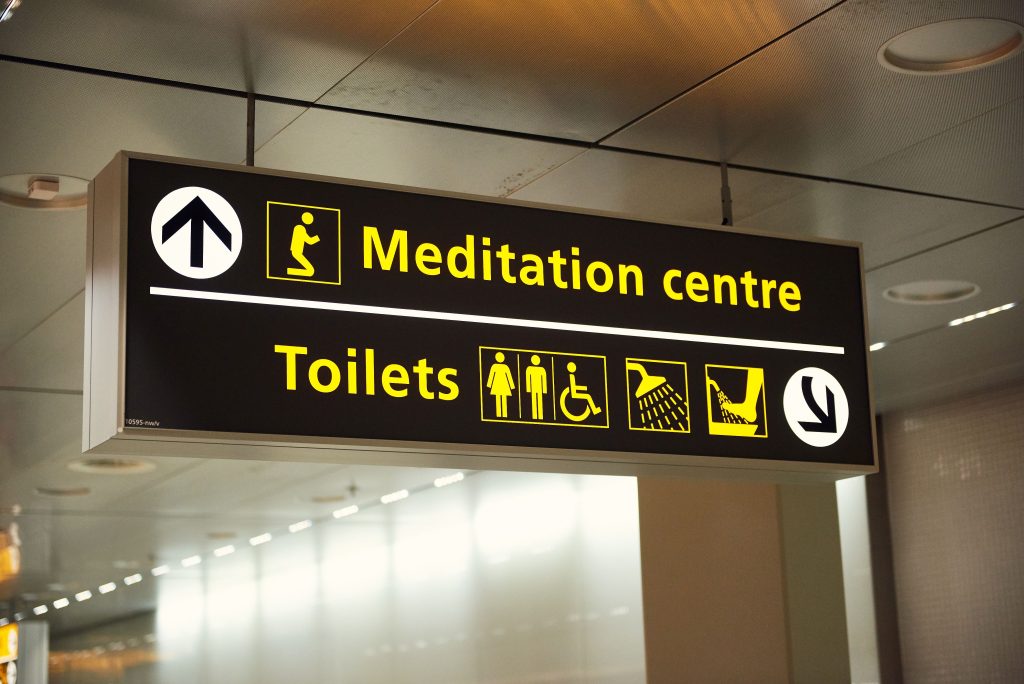
Perhaps for many people the words "airport chaplaincy" will render up images of a small unused chapel in an obscure corner of an airport, ready to receive passengers who are facing their flight with a bit of trepidation, and who are thus in need of a quiet moment. Not so the airport chaplaincy at Amsterdam Airport Schiphol. The visible presence of the chaplaincy is indeed a place of worship; but one which is new, bright and well-attended. Behind the scenes is a thriving ministry meeting the diverse needs of a constant stream of people.
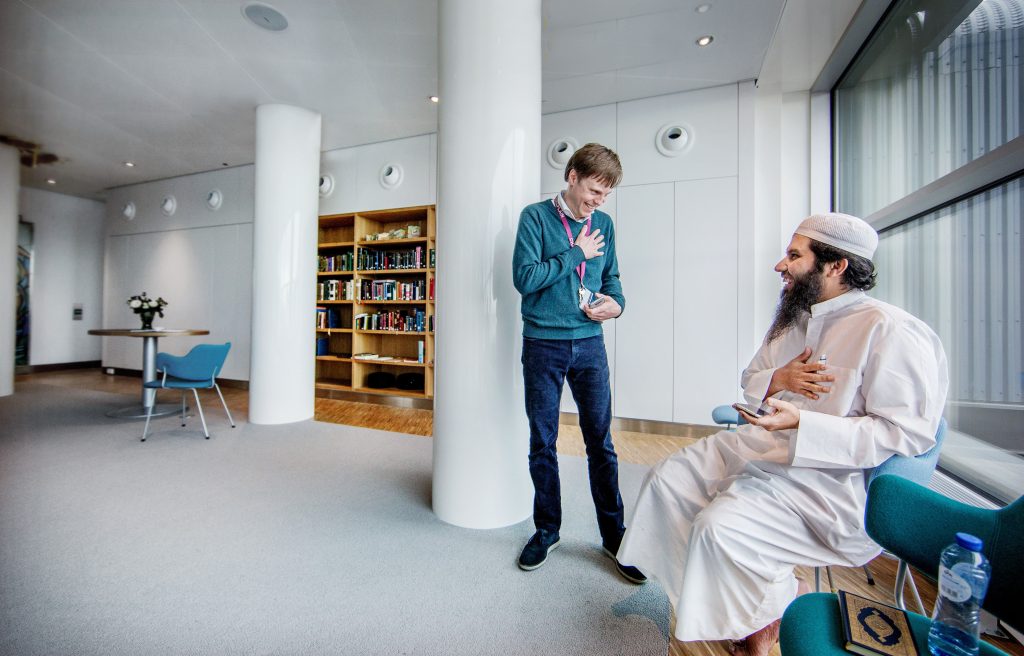
The "Meditation Centre" (Dutch: Stiltecentrum) is a modern free-standing structure of smoked glass and cool tones located in a large open space on the upper level of the intercontinental lounges. This purpose-built chapel has been placed under a clear glass roof, and has three rooms: a large quiet room for prayer or meditation, a reading room with books, magazines and other materials, and a meeting room/office where visitors are welcome to speak with a staff member. Groups who are in the company of their own minister are welcome to use the quiet room for their own services, and a wardrobe contains all the necessary supplies for Christian services. Regular weekly services are held on Sunday at 11:00, and are presided over by airport chaplains. On average, more than one hundred people use the room daily.
Through various channels contact is made with the airport chaplaincy whenever assistance is required with a spiritual or emotional need. A key part of the chaplains' work is maintaining excellent contacts throughout the entire airport - information desks, telephone information services, the Royal Dutch Military Police, counter personnel of the airlines, customs, security, etc. Through these channels comes a range of requests.
Good contacts are maintained with all the major travel insurers in the Netherlands. They provide for the repatriation of passengers whenever there has been a death outside the Netherlands - when a partner or family member dies while on a trip, or when a family member back home dies. The family will want to meet the traveller as quickly as possible upon return, and receiving them in a hectic arrivals hall is hardly suitable. The airport chaplaincy is contacted and provides for family members to be accompanied to the gate, where they can have their initial family time in some privacy. Sometimes accompaniments involve German or Belgian travellers whose port of entry back into Europe is Amsterdam.
Amsterdam Airport Schiphol is one of the few airports which has a fully operational mortuary, capable of handling up to 40 bodies. On average the mortuary deals with approximately 2000 bodies per year, about 60 % of which are in repatriation or transit to foreign places of burial and 40% returning to the Netherlands. On occasion the airport chaplaincy will be called in to accompany the bereaved on their visit to the mortuary.
The airport chaplaincy has, within the framework of the overall emergency plan, a distinct function described in the protocol for disasters response at Schiphol airport. In cases of emergency, depending on the size and nature of the incident, the airport chaplaincy is responsible to call up co-workers and pastors/ministers in the region. Regular training days are held to maintain preparedness.
As with many transportation centres, Schiphol Airport - also a major train station - has its share of homeless persons who make it their "home". Schiphol Plaza, a covered shopping arcade just outside of airline arrivals and just above the train station, is an ideal place in the eyes of the homeless: dry, warm, busy, and plenty of people discarding leftover food on their way to train or airplane. In 2002 the airport chaplaincy played the leading role in bringing a permanent presence of the Salvation Army to Schiphol, and this organisation now maintains an intake centre for the homeless who seek help. The airport chaplaincy continues to fulfil an advisory role in the development of care for the homeless.
As mentioned above, the airport chaplaincy provides for one Sunday church service at 11:00. The chaplains lead the service from the liturgy and tradition of their own denomination, but in an inclusive manner - all are welcome to attend and participate regardless of denominational background. The congregation varies in size from week to week - from just a few to upwards of around 40. Knowing that the fellow Christians with whom one is gathered will, within twenty-four hours, literally be scattered around the globe brings a poignant realisation of what it means to be part of the world-wide church. In this room Christians who might otherwise never have anything to do with those of other denominations sit side by side and share the peace of Christ.
The volunteers of the airport chaplaincy are a vital part of the ministry. But naturally, having over 20 volunteers means that much time and energy is put into training, organising, and caring for this group. A bimonthly roster is maintained, so that a volunteer is on duty at the chapel seven days a week, in two shifts, from 9:00 to 13:00 and 13:00 to 17:00 (the chapel doors are opened by airport employees at 6:00 and closes again at 23:00). Volunteer duties include keeping the rooms clean and tidy, preventing conflicts or abuse of the facility (picnicking!), and being available for a chat. A logbook is kept with an entry for each shift, and visitors are able to write their thoughts down in a guest book.
The airport chaplaincy receives many requests for help which it itself is not able to fulfil. In such cases it is of vital importance to know how to steer the request in the right direction. As such, maintaining relations with, and understanding how other assistance organisations operate, is a key function of the airport chaplaincy. These organisations are the most frequent guests at the bimonthly meeting of chaplaincy volunteers, giving presentations on their work which will enable us to provide seamless overall care of travellers or employees.
Finally, the most obvious: the airport chaplaincy is there for passengers. People who are travelling often feel vulnerable, afraid, or disorientated. It can be a great comfort to have a safe place to go and a safe person to talk to. The factor of anonymity also plays a part: in many instances people find that they are able to share burdens which they have never shared with anyone before. They may be free to ask questions they have never asked before. In this sense, conversations with passengers can sometimes tend toward the "confessional" – an unburdening of feelings or thoughts with someone who is trustworthy, but who is far removed from the home environment. A wealth of personal experiences attest to this; in all these things and more, the opportunities for being an agent of God's grace are never ending.
|